
-
Hello there guest and Welcome to Modular Fox Mustangs home of the 2V, 3V, 4V, Coyote Modular Mustang Conversion Information Website!
To gain full access you must Register. Registration is free and it takes only a few moments to complete.
Already a member? Login here then!
You are using an out of date browser. It may not display this or other websites correctly.
You should upgrade or use an alternative browser.
You should upgrade or use an alternative browser.
4v navi heads comparable to any 4.6 4v head?
- Thread starter n2ostang
- Start date

DOHC Engines
The Modular V-8's greatest asset has long been the deep-breathing four-valve head. The way this head works is simple. There are two intake valves and two exhaust valves in each chamber. Below 3,000 rpm, we're on the primary port in the intake manifold, with the secondary butterflies closed. When we mash the throttle and open the secondaries, we're on both intake valves, taking full advantage of airflow. This was a good idea in theory, but in actual use, it didn't work very well in the beginning. Low- to mid-range torque was poor with these engines in normal driving, despite a big burst of power at high rpm at wide-open throttle.
Beginning in 1999, Ford went with the Tumble Port head. As its name implies, the Tumble Port tumbles the air and fuel as it rolls into the chamber, keeping fuel droplets in suspension. Not much changed aside from the shape of the chamber, which improved low- to mid-range torque. The 5.4L DOHC got its own kind of Tumble Head at the same time for use in the Lincoln Navigator.
"In 1999, Ford improved the DOHC head, just like it did with the SOHC. This is the DOHC PI head, correctly known as the Tumble Port head."
Ford brought performance enthusiasts the FR500 four-valve head in 2002 from Ford Racing Performance Parts. Although mostly a racing cylinder head, it does have a purpose on the street--yielding as much as 7,000 rpm and a whopping 500 hp. Bolt these onto your DOHC and make as much as 50 more horsepower from the heads alone.
The FR500 head is similar to the '03 Cobra cylinder head, which was introduced with an Eaton supercharger. This head's intake ports flow 233 cfm at .500-inch valve lift. Exhaust ports yield 168 cfm. These factors make the '03-'04 Cobra head a popular head with performance buffs that love Mod motors. Mercury copped this head for the '03-'04 Marauder; ditto for Ford with the Mustang Mach 1 and Lincoln's Aviator.
Like the SOHC engine, the DOHC has twin camshafts with pressed-on lobes. The primary lobe profile is different than the secondary lobe profile. This means two different cam profiles for each engine: one for intake and one for exhaust. The aftermarket offers billet camshafts for the Ford DOHC.
So, which head is best for your 4.6L DOHC project? It can be safely said Ford has a healthy variety of factory DOHC castings that will work well for your four-valve project.
Read more: http://www.mustangandfords.com/tech...r_v8_engine_part_2/viewall.html#ixzz1i1WKws1Y
The Modular V-8's greatest asset has long been the deep-breathing four-valve head. The way this head works is simple. There are two intake valves and two exhaust valves in each chamber. Below 3,000 rpm, we're on the primary port in the intake manifold, with the secondary butterflies closed. When we mash the throttle and open the secondaries, we're on both intake valves, taking full advantage of airflow. This was a good idea in theory, but in actual use, it didn't work very well in the beginning. Low- to mid-range torque was poor with these engines in normal driving, despite a big burst of power at high rpm at wide-open throttle.
Beginning in 1999, Ford went with the Tumble Port head. As its name implies, the Tumble Port tumbles the air and fuel as it rolls into the chamber, keeping fuel droplets in suspension. Not much changed aside from the shape of the chamber, which improved low- to mid-range torque. The 5.4L DOHC got its own kind of Tumble Head at the same time for use in the Lincoln Navigator.
"In 1999, Ford improved the DOHC head, just like it did with the SOHC. This is the DOHC PI head, correctly known as the Tumble Port head."
Ford brought performance enthusiasts the FR500 four-valve head in 2002 from Ford Racing Performance Parts. Although mostly a racing cylinder head, it does have a purpose on the street--yielding as much as 7,000 rpm and a whopping 500 hp. Bolt these onto your DOHC and make as much as 50 more horsepower from the heads alone.
The FR500 head is similar to the '03 Cobra cylinder head, which was introduced with an Eaton supercharger. This head's intake ports flow 233 cfm at .500-inch valve lift. Exhaust ports yield 168 cfm. These factors make the '03-'04 Cobra head a popular head with performance buffs that love Mod motors. Mercury copped this head for the '03-'04 Marauder; ditto for Ford with the Mustang Mach 1 and Lincoln's Aviator.
Like the SOHC engine, the DOHC has twin camshafts with pressed-on lobes. The primary lobe profile is different than the secondary lobe profile. This means two different cam profiles for each engine: one for intake and one for exhaust. The aftermarket offers billet camshafts for the Ford DOHC.
So, which head is best for your 4.6L DOHC project? It can be safely said Ford has a healthy variety of factory DOHC castings that will work well for your four-valve project.
Read more: http://www.mustangandfords.com/tech...r_v8_engine_part_2/viewall.html#ixzz1i1WKws1Y
4-valve
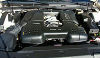

4.6 L 4-valve DOHC InTech V8 installed in a 1996 Lincoln Mark VIII
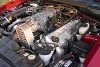
4.6 L 4-valve DOHC supercharged V8 installed in a 2003 Ford Mustang SVT Cobra
The 4-valve DOHC version of the Modular engine was introduced in the 1993 Lincoln Mark VIII as the 4.6 L Four-Cam V8. Lincoln marketed the engine under the name InTech after 1995.[5]
The 1993–1998 4-valve engines featured cylinder heads with two intake ports per cylinder (split-port) and variable runner length intake manifolds with either vacuum or electrically activated intake manifold runner controls (IMRC) depending on application. The engine was revised for 1999 with new cylinder heads featuring tumble-style intake ports (one intake port feeding two intake valves), new camshaft profiles, and fixed runner-length intake manifolds. These changes resulted in more power, torque and a broader power-band when compared to the earlier 4-valve engines.
All 4.6 L 4-valve engines featured aluminum engine blocks with 6-bolt main bearing caps, the only exception being the 2003–2004 SVT Cobra which had a 4-bolt main cast iron block. The 1999 and earlier engines featured an aluminum block cast in Italy by Fiat subsidiary Teksid S.p.A. Since 1996, all of the 4.6 L 4-valve engines manufactured for use in the SVT Cobra have been hand-built by SVTtechnicians at Ford's Romeo, Michigan plant.[6]
The 4-valve DOHC 4.6 L engine was on the Ward's 10 Best Engines list for 1996 and 1997.
Vehicles equipped with the 32-valve DOHC 4.6 L include the following:

4.6 L 4-valve DOHC InTech V8 installed in a 1996 Lincoln Mark VIII

4.6 L 4-valve DOHC supercharged V8 installed in a 2003 Ford Mustang SVT Cobra
The 4-valve DOHC version of the Modular engine was introduced in the 1993 Lincoln Mark VIII as the 4.6 L Four-Cam V8. Lincoln marketed the engine under the name InTech after 1995.[5]
The 1993–1998 4-valve engines featured cylinder heads with two intake ports per cylinder (split-port) and variable runner length intake manifolds with either vacuum or electrically activated intake manifold runner controls (IMRC) depending on application. The engine was revised for 1999 with new cylinder heads featuring tumble-style intake ports (one intake port feeding two intake valves), new camshaft profiles, and fixed runner-length intake manifolds. These changes resulted in more power, torque and a broader power-band when compared to the earlier 4-valve engines.
All 4.6 L 4-valve engines featured aluminum engine blocks with 6-bolt main bearing caps, the only exception being the 2003–2004 SVT Cobra which had a 4-bolt main cast iron block. The 1999 and earlier engines featured an aluminum block cast in Italy by Fiat subsidiary Teksid S.p.A. Since 1996, all of the 4.6 L 4-valve engines manufactured for use in the SVT Cobra have been hand-built by SVTtechnicians at Ford's Romeo, Michigan plant.[6]
The 4-valve DOHC 4.6 L engine was on the Ward's 10 Best Engines list for 1996 and 1997.
Vehicles equipped with the 32-valve DOHC 4.6 L include the following:
- 1993–1998 Lincoln Mark VIII, 280 hp (209 kW) and 285 lb·ft (386 N·m)
- 1995–1998 Lincoln Continental, 260 hp (194 kW) and 265 lb·ft (359 N·m)
- 1996–1998 Ford Mustang SVT Cobra, 305 hp (227 kW) and 300 lb·ft (407 N·m)
- 1997–1999 Panoz AIV Roadster, 305 hp (227 kW) and 300 lb-ft (407 N-m)
- 1995–1998 Lincoln Mark VIII LSC, 290 hp (216 kW) and 295 lb·ft (400 N·m)
- 1997–1999 Marcos Mantis GT, 320 hp (239 kW) and 317 lb·ft (430 N·m)
- 1999–2002 Lincoln Continental, 275 hp (205 kW) and 275 lb·ft (373 N·m)
- 1999/2001 Ford Mustang SVT Cobra, 320 hp (239 kW) and 317 lb·ft (430 N·m)
- 2000–2001 Qvale Mangusta, 320 hp (239 kW) and 317 lb·ft (430 N·m)
- 2003–2005 MG X-Power SV, 320 hp (239 kW) and 317 lb·ft (430 N·m)
- 2000–2008 Panoz Esperante, 320 hp (239 kW) and 320 lb·ft (434 N·m) [7]
- 2003 Ford Mustang Mach 1, 305 hp (227 kW) and 320 lb·ft (434 N·m)
- 2004 Ford Mustang Mach 1, 310 hp (231 kW) and 335 lb·ft (454 N·m) [8]
- 2003–2004 Mercury Marauder, 302 hp (225 kW) and 318 lb·ft (431 N·m)
- 2003–2005 Lincoln Aviator, 302 hp (225 kW) and 318 lb·ft (431 N·m)
- 2003–2004 Ford Mustang SVT Cobra, Iron block, Supercharged, 390 hp (291 kW) and 390 lb·ft (529 N·m)
The 2002-2005 Explorer combined the aluminum block with 2V heads; this combination was also used briefly by the Expedition SUV.
2012 Ford Racing Performance Catalog
2012 Ford Racing Performance Catalog
hi guys im fairly new to the modular world. I am wondering if the navi heads are the same as any other 4v heads?
Ford 4V Heads
no problem you came to the right placeWell what im buildin in a 86 mustang gt with a 5.4 4v just tryin to gather as much info as i can so i can build the motor
 Hope you enjoy your stay..